

Irving, Texas has been recognized by Retirement Living as one of the best places to retire in Texas. The ranking evaluated affordability, healthcare access, safety, and overall livability.
Irving’s retirement appeal is not built around rural quiet or resort-style retirement branding. Its strength lies in infrastructure and connectivity. Positioned between Dallas and Fort Worth and adjacent to Dallas/Fort Worth International Airport, Irving provides metropolitan access without requiring residence in a dense urban core.
For independent retirees who want to reduce homeownership responsibilities while remaining active within the Dallas-Fort Worth region, that positioning carries long-term advantages.
Location as a Structural Advantage
Irving sits within the core of the Dallas-Fort Worth metroplex. Major highway corridors connect residents to North Dallas, downtown Dallas, Fort Worth, and surrounding suburbs. Dallas/Fort Worth International Airport is partially located within Irving’s boundaries, which makes regional and national travel significantly more convenient compared to outer-ring suburbs.
This central positioning supports:
- Continued travel without long airport commutes
- Proximity to adult children living across DFW
- Access to regional healthcare networks
- Connectivity to commercial districts such as Las Colinas
Independent retirement in Irving allows simplification of housing responsibilities without withdrawing from metropolitan infrastructure.
Demographics and Housing Context
According to U.S. Census Bureau QuickFacts for Irving, the city has a population of approximately 250,000 residents, and roughly 10 percent of residents are age 65 or older.
The median value of owner-occupied housing is generally reported in the low-to-mid $300,000 range depending on the reporting year. Dallas County property tax rates vary by district and assessed value. Texas does not levy a state income tax, and according to the Texas Comptroller of Public Accounts, retirement income such as Social Security benefits is not taxed at the state level.
Irving is not positioned as the lowest-cost retirement city in Texas. Its value lies in infrastructure density, access, and long-term flexibility within the DFW region.
Why Irving Works Specifically for Independent Living
Independent living in a metro suburb operates differently than in a small retirement town.
In smaller markets, independent living often centers on maintenance relief and isolation reduction within a limited service radius. In Irving, independent living exists within a layered regional ecosystem.
Residents retain access to:
- Specialty healthcare providers across Dallas and Fort Worth
- Dallas/Fort Worth International Airport for continued travel
- Retail and dining districts such as Las Colinas
- Family members living throughout the metroplex
Independent living in Irving is not about retreating from metropolitan life. It is about simplifying housing obligations while remaining connected to it.
Independent Living Costs in Irving, Texas
According to industry surveys of senior housing costs, independent living within Irving and the surrounding Dallas County market typically ranges from approximately $2,500 to $4,500 per month, depending on apartment size, amenities, and community features.
Because Irving is centrally located within the Dallas-Fort Worth metroplex, pricing generally reflects metro-area conditions rather than small-town rates. Communities located closer to commercial districts such as Las Colinas or major transportation corridors may fall toward the higher end of that range, while smaller floor plans typically fall toward the lower end.
Cost differences are usually influenced by factors such as apartment layout, inclusion of meal plans and housekeeping, and the scope of community amenities and programming.
The most accurate pricing information is obtained directly from the West Fork Village independent living community following a tour or consultation.
Independent living in Irving is not automatically less expensive than owning a home. Its advantage lies in financial predictability. Variable expenses such as exterior maintenance, repair volatility, landscaping, insurance, and property tax exposure are replaced with a structured monthly framework.
For retirees living on fixed incomes, that predictability can be as valuable as the total dollar amount itself.
Independent Living Versus Staying in a Private Home
Long-term homeowners in Irving may face ongoing responsibilities tied to aging properties. Exterior maintenance, roof repairs, HVAC replacement, landscaping, and contractor coordination require both time and financial planning.
Independent living changes that rhythm. Residents move into apartment-style housing within a professionally managed environment. Exterior maintenance and structural repair obligations are removed.
Independence remains intact. What changes is the logistical burden and unpredictability.
This shift is often proactive rather than crisis-driven.
Social Structure Within a Metro Suburb
Large suburban communities do not automatically create daily interaction. Many retirees living independently in private homes experience limited engagement after leaving the workforce.
Independent living communities provide built-in proximity to peers and structured programming that supports consistent social contact.
In Irving, this community structure exists alongside metropolitan access. Residents can engage within the community while still maintaining freedom to explore the broader region.
That balance differentiates independent living in Irving from both rural retirement towns and dense urban high-rise living.
Healthcare Access and Long-Term Flexibility
Independent living does not include personal care or medical support. However, proximity to healthcare remains an important consideration for long-term planning.
Irving residents have access to hospital systems operating throughout the Dallas-Fort Worth region, including Texas Health Resources, Medical City Healthcare, and Baylor Scott & White Health.
Because Irving sits within the core of the metroplex, access is regional rather than dependent on a single facility. Remaining in a dense metropolitan area reduces the likelihood of needing relocation solely for specialist access if healthcare needs evolve over time.
Independent Living at West Fork Village
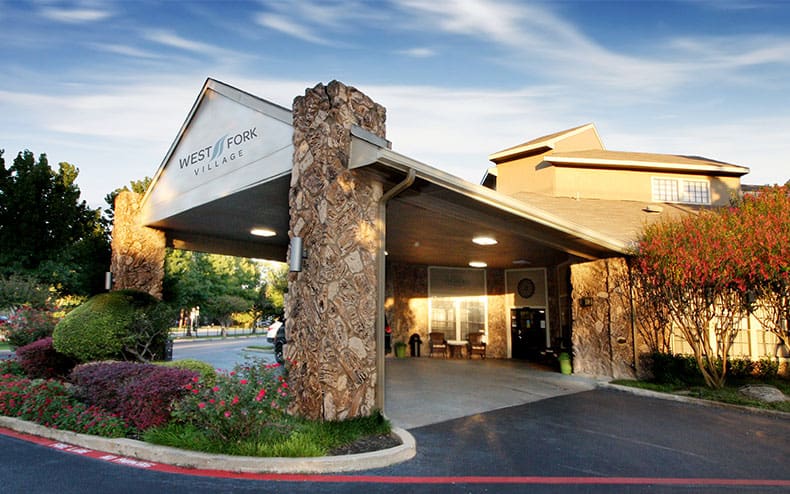
The West Fork Village independent living community offers maintenance-free housing designed for active adults who want to simplify daily responsibilities while maintaining independence.
Independent living is appropriate for individuals who do not require assistance with daily personal care but prefer relief from exterior maintenance, landscaping, and unpredictable repair coordination.
Residents live in private apartment-style residences while benefiting from community programming and shared amenities. Being located in Irving allows West Fork Village residents to combine simplified housing with continued metro connectivity.
Frequently Asked Questions
How much does independent living cost in Irving, Texas?
Industry surveys indicate that independent living in the Dallas-Fort Worth region generally ranges from approximately $2,500 to $4,500 per month, depending on apartment size and included services. West Fork Village provides individualized pricing based on apartment selection and amenities.
Is independent living less expensive than owning a home?
Not necessarily. Independent living replaces variable homeownership expenses such as maintenance, landscaping, repairs, and property tax exposure with a predictable monthly payment. For many retirees, the benefit lies in budgeting clarity and reduced responsibility rather than direct cost savings.
How is independent living different from assisted living?
Independent living is designed for active adults who do not require daily personal care or medication management. Assisted living includes support with activities such as bathing, dressing, and medication assistance. West Fork Village provides independent living services.
Is Irving a good location for independent retirement?
Irving is well suited for retirees who value airport proximity, metro connectivity, and access to regional healthcare networks. Its central position within DFW supports continued engagement beyond the community itself.
When should someone consider moving to independent living?
Many retirees consider independent living when maintaining a private home becomes burdensome or when they seek increased social interaction and simplified housing responsibilities. The move is typically proactive rather than medically required.
How to Get Started with West Fork Village
The next step is simple: see the community, meet the team, and ask the important questions about services, lifestyle, and support.
Book a tour
Reach out by phone or use the visit request form on the West Fork Village community page to schedule a tour.
During your visit, you can walk the community, explore living spaces and amenities, and talk through your needs such as daily assistance, activity preferences, dining options, and personal goals with staff.
Call for advice or questions
Call 479-631-5999 to speak with someone who can walk you through pricing, current availability, floor plans, services offered, and what a typical day looks like at West Fork Village.
Use that call to clarify whether independent living, assisted living, or memory care support is the right fit for your situation.
Get in touch with West Fork Village
West Fork Village
1121 West 6th Street, Van Buren, AR 72956
Phone: 479-631-5999
Visit: West Fork Village
Resources
- Retirement Living – Best Cities to Retire in Texas
- U.S. Census Bureau – QuickFacts: Irving City, Texas
- Texas Comptroller of Public Accounts – Texas Taxes Overview
- Texas Health Resources – Official Website
- Medical City Healthcare – Official Website
- Baylor Scott & White Health – Official Website