


The difference between assisted living and a nursing home comes down to the level of care and who provides it. Assisted living staff support daily routines like meals, medications, and activities, while nursing homes are staffed with licensed nurses who deliver medical care and supervision 24 hours a day.
They also differ in the environment, the focus on independence versus medical necessity, and the overall cost. If mom or dad values independence and community, assisted living may be a better fit. If their health requires constant monitoring or skilled care, a nursing home provides the right support.
Families usually want to know three things right away: how much it costs, what kind of care is provided, and how long a parent or grandparent can stay. We’ll go through each of these so you have a clearer picture before making any decisions.
What Are the Differences Between Assisted Living vs. Nursing Homes?
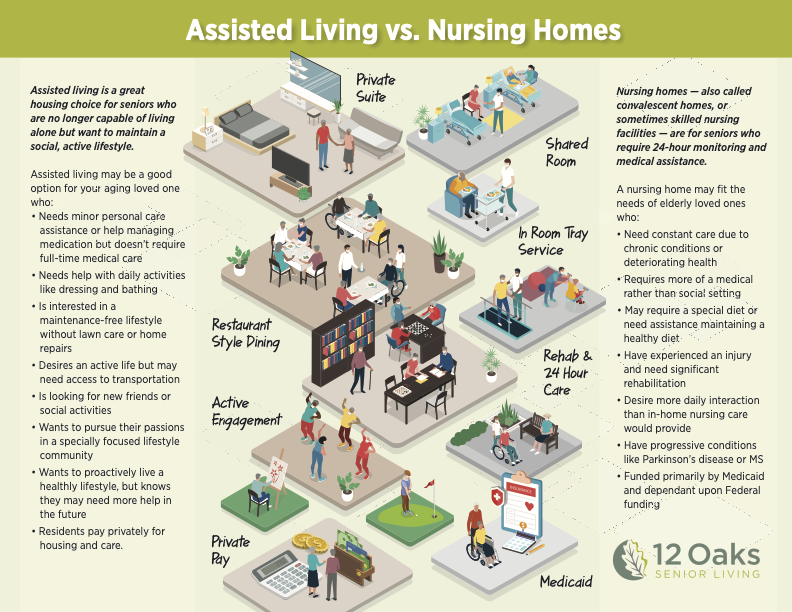
The clearest way to compare assisted living and nursing homes is by looking at four areas: the level of care, the style of living, the cost, and how each is overseen.
Assisted living is built around independence with some daily support, while nursing homes are designed for complex medical needs that require round-the-clock nursing.
What Level of Care Is Provided
Care is where the gap between assisted living and nursing homes is easiest to see.
Assisted living is designed for seniors who can live mostly on their own but need help with daily tasks — things like meal preparation, bathing, dressing, or remembering medications.
Nursing homes, by contrast, are equipped for seniors who need medical attention around the clock. Licensed nurses are always on staff, managing chronic conditions, providing treatments, and coordinating therapy services on-site.
| Aspect | Assisted Living | Nursing Home |
| Type of care | Help with daily routines (ADLs), medication reminders, meal support | Skilled nursing services, IV therapy, wound care, injections, complex medication management |
| Staff training | Caregivers trained in ADL support and safety monitoring | Licensed nurses and medical professionals |
| Availability | Staff available day and night, but not for continuous medical supervision | 24/7 medical oversight, emergency response at any hour |
| Therapy and rehab | Limited, may coordinate outside therapy visits | On-site physical, occupational, and speech therapy |
What Types Of Living Arrangements Are Available
Living space sets the tone for daily life.
In assisted living, mom or pop usually has a private or semi-private apartment, with familiar touches and common areas for dining, activities, and social time.
Nursing homes feel more clinical, with private or shared rooms designed around quick access to medical staff.
| Aspect | Assisted Living | Nursing Home |
| Room style | Private or semi-private apartments with a bedroom, bathroom, and sometimes a small kitchenette | Private or shared rooms, set up simply with easy access for staff |
| Environment | Warm and homelike, with space to stay independent | More clinical and structured, focused on medical care |
| Common spaces | Dining rooms, activity centers, gardens, and lounges where residents gather | Dining hall, therapy rooms, and nursing stations; fewer spaces for recreation |
| Privacy | More privacy and freedom to personalize the space | Less privacy; rooms arranged for quick medical support |
How Much Does It Cost?
Nursing homes cost more because they provide round-the-clock medical care and skilled nursing. Assisted living usually costs less since it covers housing, meals, and help with daily routines.
| Aspect | Assisted Living | Nursing Home |
| Average cost | Around $5,000–$6,000 per month (national median ~$5,190) | Around $10,000–$11,000 per month (national median ~$10,646) |
| What’s included | Housing, meals, help with daily activities, social programs, transportation | Housing, meals, full medical care, nursing staff, therapy services |
| Payment options | Mostly private pay; some long-term care insurance may help | Private pay, long-term care insurance, Medicaid in some cases, limited Medicare coverage for rehab stays |
| What you’re paying for | Location, size of apartment, level of personal care needed | Location, room type, medical complexity, length of stay |
Assisted living can feel more expensive than staying at home, but families often look into long-term care insurance, veterans’ benefits, or Medicaid waivers to help.
If you’re wondering how to make assisted living more affordable, know it’s one of the most common questions families ask. And communities are the best place to start since they have the experience to guide you through the options.
When Should You Choose Assisted Living vs. Nursing Home?
Nursing homes are best for seniors with ongoing health conditions that require licensed nurses every day.
Assisted living often appeals to seniors who are ready to downsize, prefer a simpler lifestyle, and want the relief of leaving behind home upkeep.
| Aspect | Assisted Living | Nursing Home |
| Best for | Seniors who want a smaller, simpler home with daily support in a community setting | Seniors with serious or chronic health conditions needing constant medical monitoring |
| Key benefits | Chef-prepared meals, lifestyle activities, community atmosphere, planned events, option for mom and dad to live under one roof | On-site rehab and therapy, tailored nutrition, enhanced safety features, medical equipment on hand, relief for family caregivers |
| Goal | Maintain independence and social connection | Provide safety, stability, and medical oversight |
| Typical resident | Parent or grandparent who prefers to downsize and let go of home maintenance | Parent or grandparent with advanced medical needs requiring licensed nurses on-site at all times |
Families often ask whether memory care communities can match the level of support in a nursing home.
Memory care, usually offered within assisted living communities, provides specialized staff, secure environments, and structured activities for seniors with dementia.
It does not replace the skilled medical care of a nursing home, but it can be the right choice when safety, consistency, and dementia-focused programming are the primary needs.
What Are Alternative Senior Living Options?
Assisted living and nursing homes aren’t the only choices. Some seniors do well in smaller settings, others prefer in-home care, and many families look for memory care programs tailored to dementia.
Communities like Life Plan Communities (also called CCRCs) bring several levels of care together on one campus, so seniors can stay in the same place even if their needs change.
| Option | What It Offers | Who It Helps Most |
| Memory care | Secure setting, dementia-trained staff, structured daily routines | Seniors with Alzheimer’s or other dementias who need safety and consistency |
| Life Plan Communities / CCRCs | Independent living, assisted living, and nursing care all on one campus | Seniors who want stability and the ability to “age in place” without moving |
| Board-and-care homes | Small, residential houses with caregivers on-site | Seniors who prefer a homelike setting with fewer residents |
| In-home care | Caregivers visit the senior’s own home for daily support or nursing services | Seniors who want to stay at home but need help with daily activities or health needs |
| Niche retirement communities | Lifestyle-focused settings (faith-based, veterans, artists, LGBTQ+) with supportive services | Seniors who want to live among peers with shared values, culture, or interests |
When weighing a continuing care community vs. assisted living, families often see CCRCs as the middle ground between the medical oversight of a nursing home and the lifestyle of assisted living. They give seniors the option to start independently and transition into more care without having to move.
How Long Can Someone Stay?
Assisted living is usually a long-term home. Many parents and grandparents live there for years, with the option to move into memory care or a higher level of support if their needs change.
Nursing homes can go either way. Some stays are short, focused on rehab after a hospital visit, while others are long-term when daily medical care is needed. In some cases, a parent or grandparent may only stay for as long as Medicare or long-term care insurance will cover the cost.
| Aspect | Assisted Living | Nursing Home |
| Typical stay | Long-term, often several years | Short rehab stay or long-term for ongoing medical care |
| Flexibility | Residents can move into memory care or add support as needed | Depends on health condition and insurance coverage |
| Common reasons | Downsizing, daily support, community living | Recovery from surgery, chronic illness, or end-of-life care |
| Transition | May shift into skilled nursing or memory care within the community | Often the last step in the care journey |
How Do States And and Federal Agencies Oversee Senior Care?
Assisted living communities are regulated by each state, which means the rules can look very different depending on where mom or dad lives.
Nursing homes follow federal standards, with stricter requirements for staffing, medical care, and safety.
State oversight of assisted living can feel less consistent, so it’s important to understand how your state sets and enforces its rules. Nursing homes, on the other hand, are held to nationwide standards, which makes their oversight more uniform across the country.
| Aspect | Assisted Living | Nursing Home |
| Who regulates | State agencies; rules differ by state | Federal government with national standards |
| What is the focus | Resident safety, daily care, staffing, medication support | Skilled nursing, staffing ratios, medical care, community safety |
| Scope of coverage | Limited to state rules, which vary in detail and enforcement | Broad federal oversight covering all licensed facilities |
| Enforcement | Inspections, licensing renewals, state-specific penalties | Regular federal inspections, quality ratings, and penalties for violations |
For families, knowing who oversees each setting makes it easier to find reliable information.
State agencies can answer questions about a community’s license, inspection history, or whether your state offers payment help through Medicaid waivers.
Federal agencies, like the Centers for Medicare & Medicaid Services (CMS), publish nursing home ratings online so you can see how facilities compare.
FAQs: Assisted Living vs. Nursing Homes
1. How does assisted living differ from nursing home care?
Assisted living offers daily support like meals, medications, and activities in a homelike setting. Nursing homes provide 24/7 medical care from licensed nurses, with therapy and treatments available on-site.
2. How do I know if my mom needs an assisted living or nursing home?
If she mainly needs help with meals, medications, or downsizing, assisted living may fit. If her health requires constant medical oversight, treatments, or rehab, a nursing home is the safer choice.
3. What is the highest level of assisted living?
Many assisted living communities provide “enhanced care” — help with two-person transfers, incontinence care, or more frequent nursing visits. It’s still not the same as a nursing home, but it bridges the gap for seniors with higher support needs.
4. What is one of the biggest drawbacks of assisted living?
Assisted living isn’t designed for round-the-clock medical care. If a parent’s health declines, they may need to transition to a nursing home or another higher level of care.
5. Who pays for assisted living?
Most families pay privately, sometimes with help from long-term care insurance. Medicare does not cover assisted living, while Medicaid coverage depends on the state.
Medicare does not cover assisted living. Medicare coverage for assisted living depends on the state.
Finding the Right Fit for Your Family
The difference between assisted living and a nursing home is about the kind of life your parent or grandparent will have each day.
Assisted living leans toward independence, community, and relief from the chores of homeownership. Nursing homes lean toward safety, medical oversight, and stability when health needs are complex.
The right fit comes from looking at both sides together: the level of care required and the lifestyle your parent or grandparent values most. When you match support with dignity, medical attention with comfort, and cost with long-term planning, the decision becomes clearer.
Families often feel most confident when they picture their parent’s daily routine in each setting and ask, “Where will they feel most supported and at ease?”
Life at 12 Oaks Senior Living Communities
A senior assisted living community can be a perfect alternative when your loved one requires more assistance than family members can safely provide at home.
For years, our communities have been keeping our residents safe, active, and connected to their families. 12 Oaks Senior Living strives to create an environment where your loved one feels at ease, protected, and safe.
Each community is committed to providing a warm, welcoming environment that feels like an extension of your family.